
Fall Prevention in Philadelphia: What We Learned From 10 Weeks of Fall Down / Stand Up
If you spend enough time walking around Society Hill or Queen Village, you quickly realize that balance is not something that only matters in a gym.
Brick sidewalks shift. Curbs appear where you are not expecting them. SEPTA buses start moving. Someone steps into your path. You look over your shoulder while crossing the street. Your foot catches something you never saw.
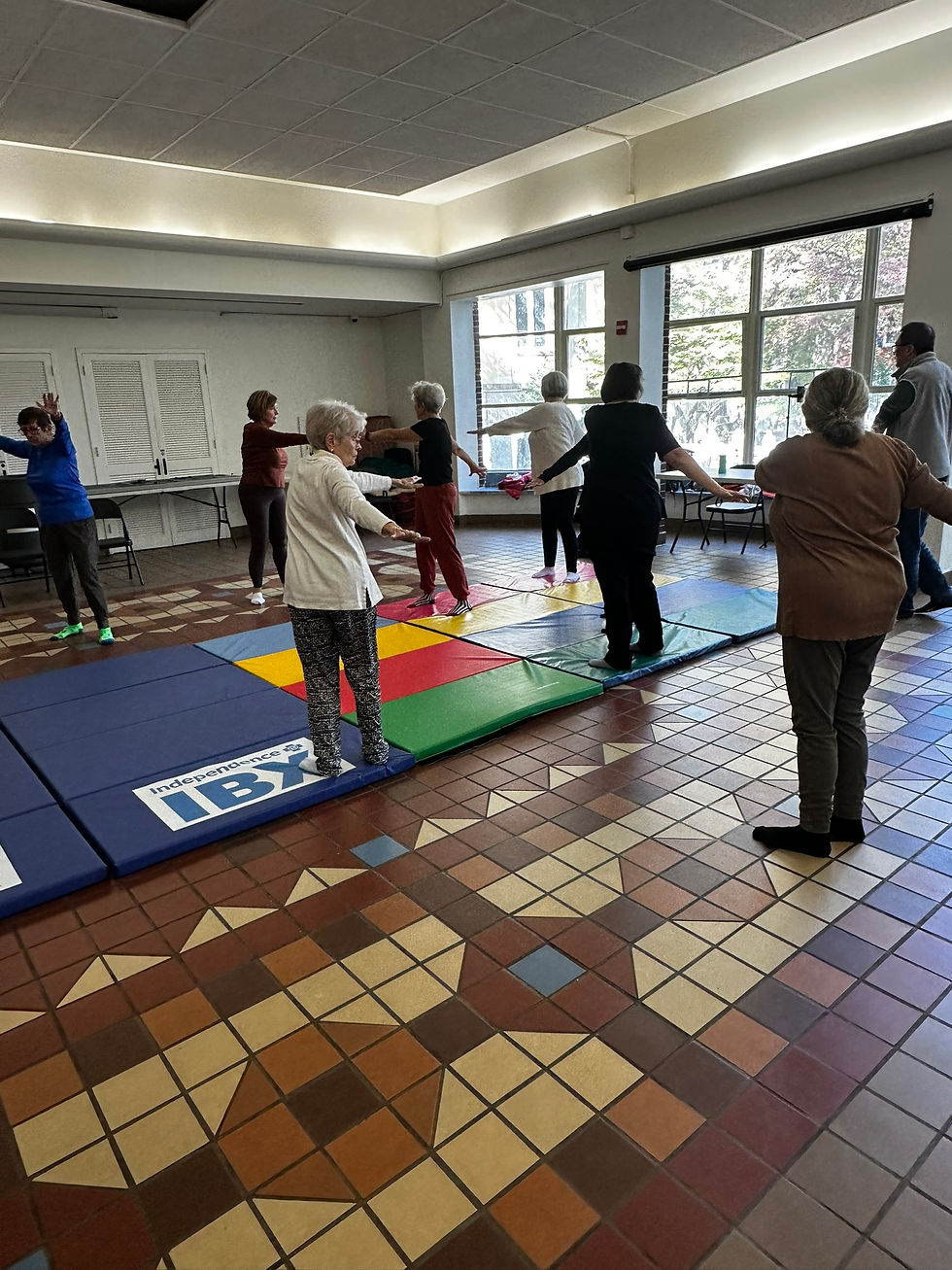
That real-world version of balance was at the heart of Fall Down / Stand Up, our 10-week community program at The Neighborhub (former Old Pine Community Center), made possible with the support of Independence Blue Cross.
At Triad Wellness Philly, we spend a lot of time thinking about what it actually takes to age well. Preventing falls is part of that, but our goal is bigger: helping people maintain the strength, balance, confidence and physical independence to keep living their lives.
The CDC reports that more than one in four adults age 65 and older falls each year. Falls are also the leading cause of injury among older adults. CDC
But getting older does not mean simply accepting worse balance.
Balance Is a Skill, Not Something You Either Have or Don’t
Throughout Fall Down / Stand Up, we kept returning to one message:
Balance can be trained.
We started with basic body awareness. Participants learned the tripod foot, using the heel, ball of the big toe and ball of the little toe to better understand their connection to the ground. We introduced the stack, or the relationship between the pelvis, rib cage and head, so people could better recognize where their body was relative to their base of support.
From there, the work became progressively more complex.
We trained sit-to-stands and controlled lowering for leg strength and deceleration. We practiced tandem stance and weight shifting. We explored the difference between simply holding your balance and reactive balance, which is your ability to regain control after something unexpected happens.
We practiced stepping forward, backward, sideways and diagonally. We used clock-face drills, reaching, rotation through the hips and spine, the Three Point Touch Test, recovery stepping, and walking while responding to imaginary curbs, puddles and obstacles.
Eventually we added divided attention, because nobody walks through Philadelphia while thinking exclusively about their balance. We walk while talking, looking for traffic, carrying groceries, reading signs and reacting to the people around us.
Judith Sachs collaborated with us on the fall-recovery portion of the series, giving participants opportunities to explore falling, the floor and getting back up.
The idea was simple: train what happens before a fall, while also becoming better prepared for what happens if you do reach the ground.

What Participants Told Us
The feedback was one of the most rewarding parts of the program.
Among the 18 participants who completed our anonymous evaluation, 17 reported greater confidence in their balance, and 17 reported greater confidence around falling, getting closer to the floor or getting back up.
Every respondent said they would recommend the program to someone else.
More important than the numbers were the ways people described using what they learned in everyday life.
“Body awareness, helpful on the chaotic City streets and on public transportation.”
Another participant wrote:
“Tripod. Flexing my toes as I walk has made a huge difference in balance. I feel more secure.”
And another described the program this way:
“The program gives you exercises to get you started on improving strength and balance to prevent falling and movements to help you control your landing and get up if you do fall. And you don't need fancy equipment.”
One participant summed up what we hope people take away from this work:
“You can improve your balance but you have to think while you walk.”
That last part matters. A 10-week class can teach skills, but maintaining those skills requires practice.
Fall Prevention Does Not End When the Class Ends
Our biggest message at the end of the series was that strength, balance, reaction and coordination are skills.
Skills improve when you practice them.
You do not necessarily need another hour-long workout every day. A few minutes of thoughtful, consistent practice can keep challenging the systems that help you stay upright, react and move confidently.
That is why Fall Down / Stand Up is not the end of this work at Triad.
Beginning in January, we are launching an ongoing Stand Up to Falls: Strength & Balance class on Wednesdays at the Neighborhub. Registration information will be available soon.
For people who prefer to train from home, our Stand Up to Falls online programs provide structured balance and fall-prevention training that can be done on your own schedule.
And for someone who wants individualized help, Triad also provides 1-on-1 balance and fall-prevention training in Philadelphia. We can meet you where you are, evaluate your individual strength, balance and mobility needs, and build a program around your goals.

Common Questions About Balance and Fall Prevention
What is the best exercise for improving balance as you age?
There is no single best balance exercise.
Standing on one foot can be useful, but real-life balance requires much more. You need enough leg strength to control your body, the ability to shift your weight, step in multiple directions, slow your momentum, react to unexpected changes and coordinate movement while your attention is somewhere else.
Exercises we regularly use include sit-to-stands, tandem stance, multidirectional stepping, controlled lowering, reaction stepping and rotational balance drills.
Can balance improve after age 65?
Yes. Balance involves multiple trainable qualities, including strength, coordination, sensory awareness and reaction.
That is why we repeatedly told participants: balance is a skill.
The goal is not to eliminate every wobble. A healthy balance system is constantly making corrections. The important question is whether you can sense what is happening and respond effectively.
Where can I find fall prevention and balance classes in Philadelphia?
Triad Wellness Philly offers balance and healthy-aging programming in the Society Hill and Queen Village area of Philadelphia.
Our ongoing Stand Up to Falls: Strength & Balance class begins in January, with registration details coming soon.
We also offer private balance training for people who want more individualized coaching.
What should I do if I’m afraid of falling?
Fear is worth taking seriously, but avoiding movement altogether can work against you.
Start somewhere you feel safe. Use sturdy support when appropriate. Build strength. Practice weight shifting and stepping. Gradually expose yourself to manageable balance challenges rather than immediately choosing the hardest variation.
And if your balance has changed suddenly, you are experiencing unexplained dizziness, or you have had repeated falls, talk with your healthcare provider as well.
Can a personal trainer help with balance?
A qualified coach can help determine why a particular balance task is difficult and train the underlying qualities.
Sometimes the limitation is strength. Sometimes it is mobility. Sometimes it is confidence, reaction speed, coordination, foot awareness or simply a lack of practice.
That is one reason individualized training can be valuable: the exercise can meet the person instead of forcing the person to fit the exercise.
Building Better Ways to Age in Philadelphia
Fall Down / Stand Up reinforced something we already believed at Triad Wellness:
People do not need to be treated as fragile simply because they are getting older.
They need opportunities to practice.
They need strength. They need skills. They need good coaching. And they need places in their own community where they feel comfortable doing the work.
We are grateful to Independence Blue Cross, The Neighborhub, Judith Sachs, and especially the neighbors who showed up week after week and trusted us to challenge them.
Triad Wellness is continuing to build a comprehensive system for fall prevention, balance training, strength and healthy aging in Philadelphia because staying independent should not be left to chance.
To learn about the upcoming Stand Up to Falls: Strength & Balance class, stay tuned for January registration information by subscribing to our newsletter.
To start training from home, visit Stand Up to Falls.
For individualized balance, strength or fall-prevention training at Triad Wellness, schedule a free intro call.


Comments